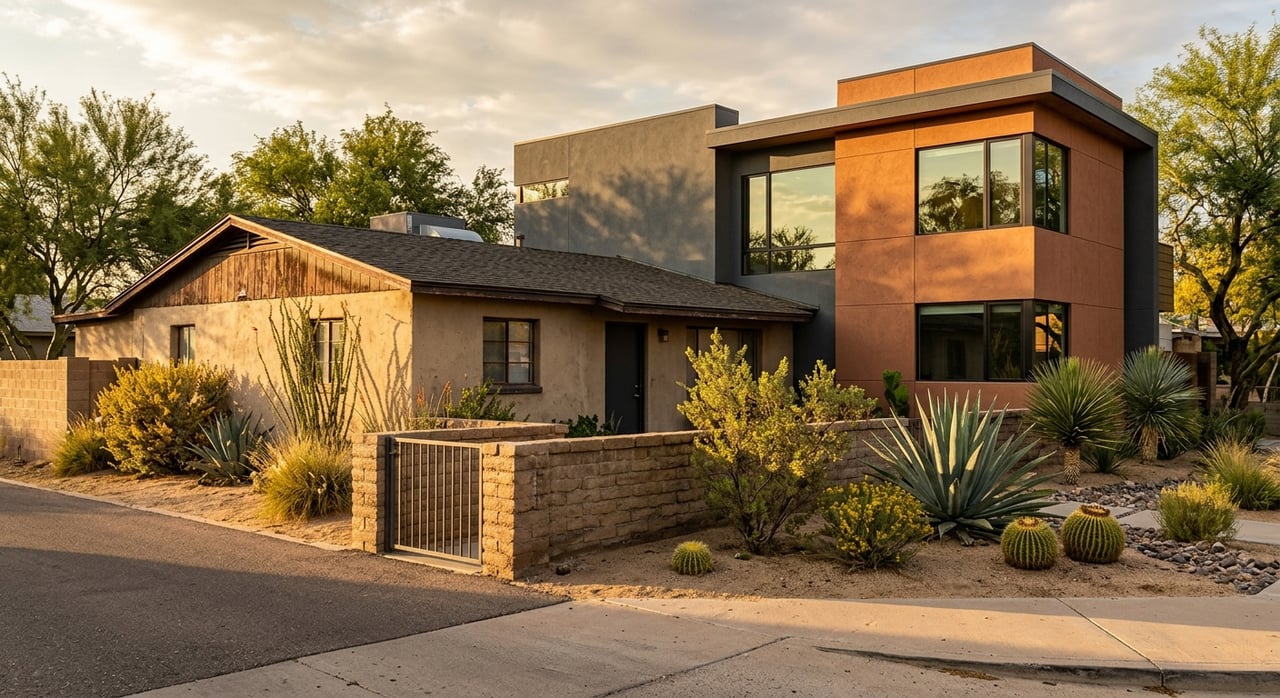
Peoria Infill Market Snapshot For Builders
April 23, 2026
April 23, 2026
If you are sizing up Peoria for your next infill play, the key question is not whether the city is growing. It is where infill actually fits and what product the market is most likely to absorb. For builders, Peoria offers a useful middle ground: a stable owner-occupied market, pricing above several West Valley peers, and a few clear pockets where tighter-lot development makes sense. Let’s dive in.
Peoria is a large, established northwest Valley city with about 199,932 residents, a median age of 43.3, median household income of $97,333, and an owner-occupied housing rate of 76.0%, according to Census Reporter. Those numbers point to a mature housing market with a strong base of long-term homeowners.
That matters if you are evaluating infill risk. In a market with a high owner-occupied share, demand tends to be tied more closely to end users than to short-term speculation. For builders, that usually supports more disciplined underwriting and a clearer read on real buyer preferences.
As of March 2026, Redfin's Peoria housing market data shows a median sale price of $540,000, about 52 days on market, and a median sale price per square foot of $254. Peoria sits above Surprise, Glendale, and Goodyear on median sale price, while remaining well below Scottsdale.
The practical takeaway is simple: Peoria is in a move-up price tier for the West Valley. It can support quality and good lot positioning, but it is not priced like a pure luxury market. That creates room for well-designed detached product that still needs to feel value-conscious.
Peoria is better understood as a suburban market with selective infill nodes, not a city where infill works everywhere. A census-derived housing profile cited in the research shows about 77.6% of housing is single-family detached, and only 2.7% of units were built in 2014 or later, according to PubRecord's Peoria housing profile.
That housing mix tells you a lot. The city still leans heavily detached in character, and the newer-construction share is relatively small. If you are looking for urban-style infill conditions across the whole city, Peoria is not that story.
At the same time, the city's planning framework shows Peoria is managing multiple growth patterns at once. The Peoria zoning map tracks areas such as the Old Town Specific Plan, Downtown Redevelopment Plan, Central Peoria Specific Plan, Lake Pleasant/North Peoria, and Loop 303, which highlights the split between core redevelopment and edge growth.
For builders, this means location selection matters more than broad city averages. Some subareas support a tighter, more urban infill concept, while much of the city still favors conventional suburban detached housing.
In Peoria's single-family districts, R1-6 zoning standards allow a minimum lot area of 6,000 square feet, a minimum width of 50 feet, a minimum depth of 100 feet, and maximum lot coverage of 45%. The district also allows a 30-foot height limit, with a 20-foot front setback for front-facing garages and a 10-foot front setback for side-entry garages.
Those standards are important because they define the lower end of Peoria's conventional detached-home envelope. You can work with narrower suburban lots than some builders may expect, but the form still reads as detached housing unless a specific plan or overlay allows something different.
This is one reason smaller detached homes and patio-home style product often make more sense than forcing a denser format onto a parcel that does not support it cleanly. The zoning gives some flexibility, but it does not erase the city's suburban framework.
The clearest infill opportunity is in Peoria's core planning areas, especially Downtown and Old Town. In the Downtown District standards, there is no minimum parking requirement, residential projects can use 10-foot front, rear, and side setbacks, the height limit is 30 feet, and maximum lot coverage for single-family residential projects is 45%.
That is a much more flexible setup than conventional suburban zoning. For builders, it opens the door to tighter-lot homes, small-cluster layouts, and more efficient site planning than you would typically achieve in standard detached districts.
The Old Town Specific Area Plan reinforces that direction. It calls for a small-block, low-rise district and encourages pedestrian-scaled mixed-use infill and redevelopment along Washington Street and 83rd Avenue.
If you are looking for true infill logic in Peoria, this is where it becomes most visible. The city's own planning documents point to core locations where tighter urban form is not just possible, but aligned with the intended character.
The story changes once you move to newer edge-growth areas. The research notes that the Loop 303 study area is mostly undeveloped, and the Camino á Lago plan contemplates up to 3,855 single-family units at an overall density of 3.2 dwelling units per acre.
That is a clear signal that newer growth in Peoria still skews low-density and detached. In other words, the city's expansion areas are not where you would typically look for a true infill thesis. They are better read as suburban development territory.
For builders comparing acquisition targets, this helps narrow the search. If your strategy depends on compact lots or cluster-style product, older established corridors are likely a better fit than fringe growth areas built around low-density patterns.
Based on the city's housing mix, pricing, and zoning framework, the most defensible infill product in Peoria is usually one of the following:
This product fit is supported by Peoria's detached-heavy housing base, the R1-6 standards, and the flexibility found in Downtown and Old Town. It is also consistent with the city's broader character as a suburban market with a limited number of infill pockets.
For a builder, that means the safest bet is often not the densest concept. It is the product that matches local form while improving on finish level, curb appeal, and lot efficiency.
Peoria's pricing suggests a move-up buyer pool that can support better execution, but not limitless pricing. According to Redfin, Peoria's median sale price is materially above Glendale, Surprise, and Goodyear, yet still far below Scottsdale.
That creates a specific product lane. Buyers may respond to stronger finishes, appealing elevations, and functional outdoor space, but the project still needs to feel grounded in value relative to higher-priced submarkets.
Market pace also supports a measured approach. Redfin shows Peoria as somewhat competitive, with homes receiving about 2 offers on average and selling in around 52 days.
For builders, that is healthy but not speculative. It argues for realistic absorption assumptions and disciplined pricing rather than a rapid-sellout mindset.
If you are evaluating Peoria infill opportunities, focus on these filters first:
Start with submarket selection
Prioritize Old Town, Downtown, Central Peoria, and other established corridors where redevelopment logic is stronger.
Match product to zoning
In standard single-family districts, plan around detached-home form. In Downtown and similar core areas, test tighter-lot layouts where the code supports them.
Underwrite for move-up buyers
Peoria can justify quality, but value still matters. Design and finish should feel elevated without drifting into a luxury pricing assumption the market may not support.
Stay realistic on pace
A 52-day market is workable, but it is not a frenzy. Build your absorption schedule around a normal, competitive resale environment.
Look for lot-specific advantage
Under-improved parcels, older lots in established corridors, and sites with better access to core redevelopment areas may offer the cleanest infill angle.
Peoria is not a one-size-fits-all infill market. It is a suburban city with meaningful but limited infill nodes, especially near Downtown, Old Town, and other established corridors. That is the key distinction builders need to understand before chasing density in the wrong location.
The better opportunity is usually a well-designed detached or compact-cluster product that respects local form, takes advantage of the right zoning pocket, and lands at a price point that feels strong for the West Valley without trying to imitate Scottsdale. If you are evaluating lot potential, redevelopment positioning, or off-market land opportunities, Taylor Smart brings a tactical, market-first approach to builder and redevelopment strategy.
Stay up to date on the latest real estate trends.
Trust in him for expert guidance and unmatched market insight in Phoenix real estate. From high-value listings to strategic buying, he delivers drive, precision, and results—contact him to elevate your property goals.